Arkansas Dog Registration Information
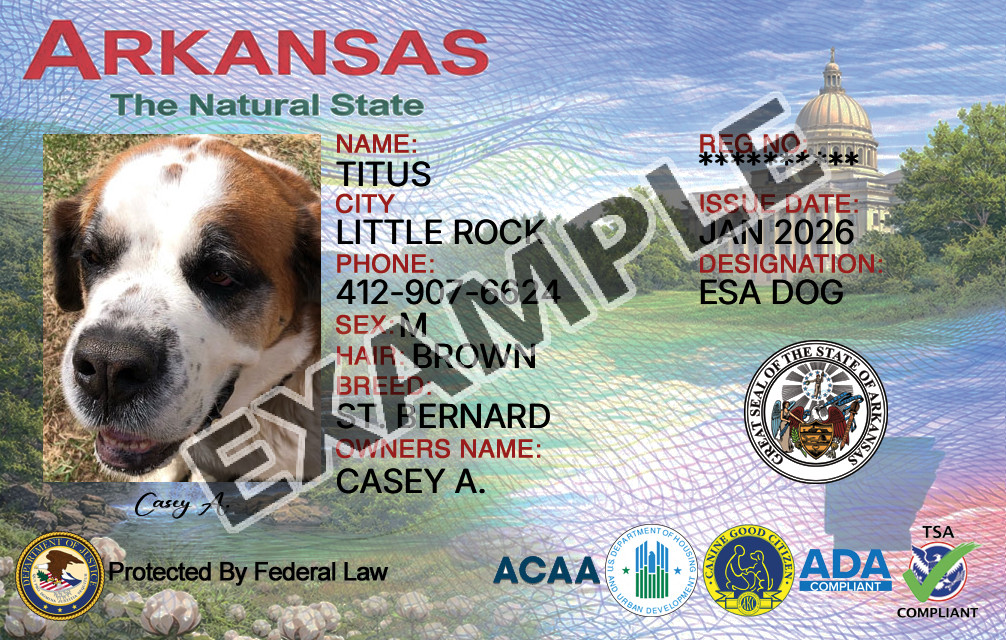
State Licensed, Service Dogs and Emotional Support Dogs in Arkansas
Registering a Dog in Arkansas: What People Usually Mean
If you’re searching “where do i register my dog in Arkansas for my service dog or emotional support dog”, you’re likely trying to do one (or more) of these things: (1) get a dog license in Arkansas (often tied to rabies vaccination), (2) confirm rabies vaccine compliance, (3) understand whether a service dog or emotional support animal (ESA) needs “registration,” or (4) find the right local office for animal control dog license Arkansas questions.
Where to Register or License Your Dog in Arkansas
In Arkansas, dog licensing and enforcement are commonly handled locally—by a city animal services department, a county animal shelter/animal control office, or another local government office. Below are several official examples to help you identify the type of office you should contact where you live. If you don’t see your city/county listed, use these as a model: look for your City Animal Services, Animal Control, or County Animal Shelter.
City of Little Rock Animal Services (Animal Village)
City of Fayetteville Animal Services
Washington County Animal Shelter (Lester C. Howick Animal Shelter)
City of Bryant Animal Control
How to choose the right office (quick guide)
- If you live inside city limits: start with your city animal services/animal control department (many cities run the licensing program).
- If you live outside city limits: check your county animal shelter/animal control resources and ask which office issues licenses (some counties refer you to a city, the sheriff’s office, or another county department).
- If you’re unsure: ask “Which office issues the dog license tag for my address?” and “What proof of rabies vaccination do you require?”
Overview of Dog Licensing in Arkansas
Is there one statewide Arkansas dog license?
For most residents, there isn’t one universal statewide online portal for licensing every dog. Instead, a dog license in Arkansas is usually created and enforced through local ordinances (city or county rules). That’s why the best answer to where to register a dog in Arkansas is typically: your city animal services/animal control office or the relevant county office for your address.
What local licensing generally does
A local license/tag program helps the community connect dogs to owners, support animal services operations, and enforce public health rules (especially rabies vaccination). Depending on your city/county, licensing may be required for:
- Dogs over a certain age (commonly 4 months or older, but it varies by locality)
- Dogs kept within a specific city boundary
- Dogs that must wear a license tag on a collar/harness when off your property (varies by local ordinance)
Rabies vaccination requirements (state-level public health rule)
Separate from any city/county license tag program, Arkansas public health rules require rabies vaccination for dogs and cats. The Arkansas Department of Health explains that Arkansas law requires dogs and cats to be vaccinated against rabies by four months of age by appropriately licensed veterinary professionals. Local governments may also use rabies vaccination proof as the key document needed to issue a license tag.
How Dog Licensing Works Locally in Arkansas
Step-by-step: what to do for your address
- Confirm where you live (city limits vs. county). Licensing rules can change at the boundary line. If you pay city utilities or vote in city elections, you’re likely within city limits—but you can verify with your local city hall or county assessor tools.
- Get/confirm rabies vaccination documentation. Most local programs require proof that your dog is currently vaccinated against rabies.
-
Call the correct licensing office.
Ask whether your locality issues:
- a physical license tag,
- a paper license certificate,
- an annual renewal vs. renewal tied to the rabies vaccine schedule, and
- any discounts for spay/neuter (if applicable locally).
- Submit the application and fee (if required). Some localities issue licenses in person; others may accept mail or online payments. Requirements vary.
- Keep the tag and records accessible. Many jurisdictions require the dog to wear the tag, and you should keep rabies proof available for boarding, grooming, travel, or if an incident occurs.
Who enforces licensing and rabies rules?
In Arkansas, enforcement usually involves a combination of:
- City animal services/animal control (for city ordinance enforcement and licensing programs)
- County animal shelters/animal control resources (especially outside city limits)
- State public health authorities (rabies prevention guidance and statewide public health rules)
What licensing is not
A local dog license is not the same thing as “registering” a dog as a service animal or emotional support animal. Licensing is about local compliance (public health and animal control). Service dog and ESA status are legal/functional categories that follow different rules, explained below.
Service Dog Laws in Arkansas
Service dog status is not created by a registry
A service dog is generally recognized based on the dog being individually trained to do work or perform tasks for a person with a disability. The legal status comes from how the dog is trained and used—not from buying a card, certificate, vest, or joining a database.
What you may still need locally: license + rabies compliance
Even when a dog is a legitimate service dog, local public health and animal control rules can still apply. That means your service dog may still need:
- Current rabies vaccination (required statewide), and
- A local license tag if your city/county requires a dog license in Arkansas for your address.
Common misunderstanding: “I need to register my service dog with Arkansas”
Most of the time, the correct action is not a statewide service dog registration. Instead, you should: (1) keep vaccination records current, (2) follow your local licensing process, and (3) understand your access rights and responsibilities as a service dog handler.
Emotional Support Animal Rules in Arkansas
ESAs are different from service dogs
An emotional support animal (ESA) provides comfort by its presence, but it is not necessarily trained to perform a specific task related to a disability. Because of that difference, ESAs are treated differently under many public access rules.
“ESA registration” vs. local dog licensing
People often search for ESA “registration,” but for government compliance the main items are usually:
- Local licensing (if your city/county requires it) and
- Rabies vaccination compliance (statewide requirement for dogs/cats).
If your goal is housing-related accommodation, you typically focus on documentation that supports an ESA request for housing purposes (when applicable)—not a purchased registry listing.
Frequently Asked Questions
Register A Dog In Other Arkansas Counties
Select your county from the dropdown below to get started with your dog’s ID card. Requirements and license designs may vary by county, so choose your location to see the correct options and complete your pup’s registration.
- Arkansas Dog License Cards
- Ashley Dog License Cards
- Baxter Dog License Cards
- Benton Dog License Cards
- Boone Dog License Cards
- Bradley Dog License Cards
- Calhoun Dog License Cards
- Carroll Dog License Cards
- Chicot Dog License Cards
- Clark Dog License Cards
- Clay Dog License Cards
- Cleburne Dog License Cards
- Cleveland Dog License Cards
- Columbia Dog License Cards
- Conway Dog License Cards
- Craighead Dog License Cards
- Crawford Dog License Cards
- Crittenden Dog License Cards
- Cross Dog License Cards
- Dallas Dog License Cards
- Desha Dog License Cards
- Drew Dog License Cards
- Faulkner Dog License Cards
- Franklin Dog License Cards
- Fulton Dog License Cards
- Garland Dog License Cards
- Grant Dog License Cards
- Greene Dog License Cards
- Hempstead Dog License Cards
- Hot Spring Dog License Cards
- Howard Dog License Cards
- Independence Dog License Cards
- Izard Dog License Cards
- Jackson Dog License Cards
- Jefferson Dog License Cards
- Johnson Dog License Cards
- Lafayette Dog License Cards
- Lawrence Dog License Cards
- Lee Dog License Cards
- Lincoln Dog License Cards
- Little River Dog License Cards
- Logan Dog License Cards
- Lonoke Dog License Cards
- Madison Dog License Cards
- Marion Dog License Cards
- Miller Dog License Cards
- Mississippi Dog License Cards
- Monroe Dog License Cards
- Montgomery Dog License Cards
- Nevada Dog License Cards
- Newton Dog License Cards
- Ouachita Dog License Cards
- Perry Dog License Cards
- Phillips Dog License Cards
- Pike Dog License Cards
- Poinsett Dog License Cards
- Polk Dog License Cards
- Pope Dog License Cards
- Prairie Dog License Cards
- Pulaski Dog License Cards
- Randolph Dog License Cards
- Saline Dog License Cards
- Scott Dog License Cards
- Searcy Dog License Cards
- Sebastian Dog License Cards
- Sevier Dog License Cards
- Sharp Dog License Cards
- St. Francis Dog License Cards
- Stone Dog License Cards
- Union Dog License Cards
- Van Buren Dog License Cards
- Washington Dog License Cards
- White Dog License Cards
- Woodruff Dog License Cards
- Yell Dog License Cards
